
Parts of North, Central, East and Northeast continue to shiver as mercury remains below normal level. Rediff.com takes a look at some of the coldest places where life has come to a standstill owing to sub-zero temperatures.
This is the third time this season, after December 8 and January 1, that visibility has dropped to zero metres in the city.

In Uttar Pradesh, two persons were killed since Tuesday in the floods which have affected around 8.7 lakh people in 987 villages of 28 districts in the state.
Delhi on Sunday recorded the lowest temperature of the season with the mercury dipping to 2.6 degrees Celsius, five notches below normal, with dense fog affecting 55 flights and about 70 trains.

The minimum temperature in the capital dropped to 9.6 degrees Celsius, three notches below normal and the lowest this season so far. The maximum is likely to settle around 27 degrees Celsius, the India Meteorological Department said.
Cold wave continued unabated in Uttar Pradesh as 13 more people succumbed to the chill in the state, taking the death toll this winter to 129.
At least 34 more deaths were reported from Uttar Pradesh, taking the total toll beyond 200 mark, as cold wave conditions continued unabated in North, East and Central parts of the country, even as temperature soared slightly in some places.
The spell of bone-chilling cold continues in Delhi, a day after the national capital witnessed its coldest day in 44 years. The maximum temperature dropped to 9.8 degrees Celsius on Wednesday. This was 11 degrees below normal. The minimum temperature on Wednesday was 4.8 degrees. At Palam, on the fringes of Delhi, the maximum temperature was 9.7 degrees.
15 more persons lost their lives due to persistent cold wave conditions in Uttar Pradesh, taking the death toll in the state this winter to 107.
At least 23 people lost their lives due to cold wave in Uttar Pradesh and Uttarakhand even as temperature in parts of North India soared, a trend that weatherman said will persist.
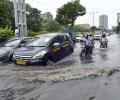
Some of the stretches and areas where waterlogging was seen included Dhaula Kuan, Mathura Road, Moti Bagh, Vikas Marg, Ring Road, Rohtak Road, Sangam Vihar, Kirari and near Pragati Maidan among others.

The Delhi government has banned construction and demolition activities in the city till November 21.
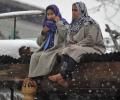
Cold wave and fog persists across North India disrupting traffic and normal life.

While the minimum was 14 degree Celsius at Mahableshwar, it was 11.6C in Mumbai.
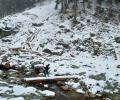
The road, the alternative link between Kashmir and rest of the country, was closed after the season's first heavy snowfall in the Jammu region.
Icy winds are blowing from the hills in northern parts of the country due to snowfall and they are causing the dip in the temperature, the Met Office said. Cold wave conditions have been declared as the temperature drop is five degrees below normal.
The lifting of the heat-trapping cloud cover over Delhi coupled with the icy northerly winds sweeping the city resulted in the minimum temperature plummetting to 3.6 degree Celsius, three notches below normal.
There was some respite for Delhiites from intense cold wave conditions on Thursday with the minimum temperature climbing over 5 degree Celsius for the first time this week even as fog forced delay of some flights.
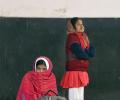
Parts of the capital woke up to dense fog on Friday with the mercury dropping to 7.4 degrees Celsius, one degree below the season's average.
All the casualties were reported from Uttar Pradesh where a dust storm claimed nine lives in Jaunpur district, four in Ballia and one each in Ghazipur and Varanasi.
Low temperature makes it the second coldest day of the season after Monday when the mercury had dipped to 3.1 degrees Celsius, making it the coldest day since December 31, 1999.

In another forecast for August, IMD Director General Mrutunjay Mohapatra said monsoon is also likely to be normal in the month.
At the airport, air traffic was back to normal and there was no delay or cancellation of flights.

Most places in Kashmir continued to reel under intense cold with the night temperature staying below the freezing point, while Kargil town in Ladakh region registered the season's coldest night at minus 9.2 degrees Celsius.
Icy winds blowing from mountains on Tuesday gave no respite to Delhiites from winter chill as it brought down mercury to below five degree Celsius.
The Met Office said this is the harshest winter in the last four decades.
A minimum of 3 Celsius was recorded on Wednesday morning compared to Tuesday's 2.6 C, MeT Office said.
Mercury dropped below freezing point at the hill station of Mount Abu as cold conditions remained in most parts of Rajasthan for fifth consecutive day.

The Manali-Leh National Highway-3 was blocked after heavy rainfall triggered landslide in Himachal Pradesh's Kullu district on Friday.
The runway visibility range at the Indira Gandhi International Airport was around 1,000 metres and all flights operated on schedule, airport sources said.

There was no relief for the national capital, with the mercury crossing the 44C mark in some parts of the city.
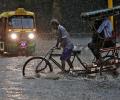
Though early days, meteorologists point towards a neutral La Nina during the initial phase of the four-month monsoon season this year that starts from June. If this holds true, by the time the rains hit the mainland, it could mean there would be one less reason to worry about the prospects of the monsoon this year. Weathermen said making any accurate prediction of how El Nino will behave and what impact it can have on the progress and distribution of rains is difficult to say at this point. A clear picture will emerge around late May or early June.
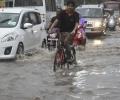
The southwest monsoon over the country is likely to be normal in July, the India Meteorological Department (IMD) said on Thursday in its forecast for the month.
Maximum temperature at around 8 am on Monday was 18.1 degree Celsius, three degree Celsius below normal. On Sunday it was 18.7 degree Celsius.
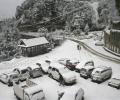
Delhi and Leh were among some of the places in northern India which recorded their lowest minimum temperatures so far this winter as the cold gained in intensity in the region.
Delhiites were spared by fog for the second day on Wednesday as the minimum temperature in the capital hovered around the seven degree Celsius mark.
All flights were on schedule, sources in the Indira Gandhi International Airport said. Trains services, however, remained partially affected due to foggy conditions in other parts of the country, railways sources said.

El Nino is expected to occur in August-September, but it is unlikely to have any major impact on the monsoon, and the weatherman expects a positive Indian Ocean Dipole, which has a strong influence on rainfall in the country.

Rain and thunderstorm wrecked havoc in several parts of Uttar Pradesh leaving at least 21 dead
Plummeting mercury, coupled with thick fog cover, threw normal life out of gear in the entire north India on Monday, with 24 more people succumbing to the chill in various parts of the region.
